Slack
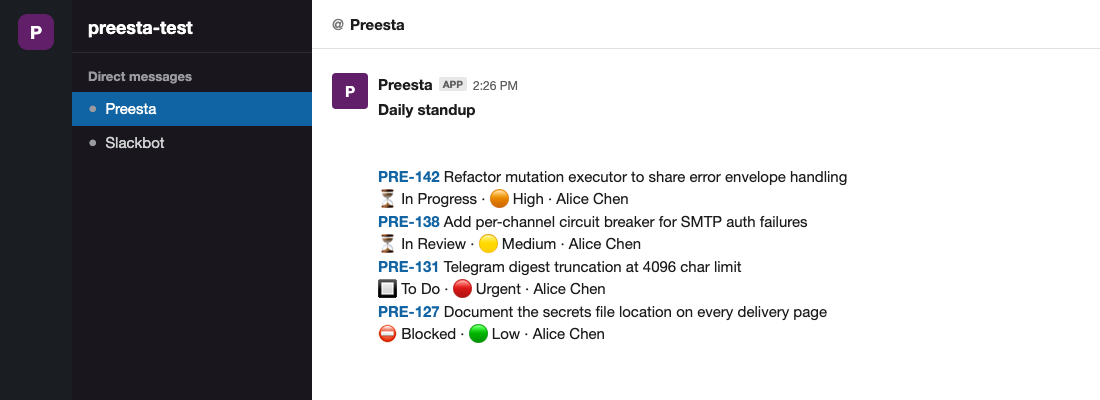
Slack delivery is personal direct messages from a workspace bot. Channels and incoming webhooks are not used — the per-rule routing model wants one DM per recipient, which webhooks can't do.
1. Create the Slack app
- api.slack.com/apps → Create New App → From scratch → pick your workspace.
- OAuth & Permissions → Scopes → Bot Token Scopes, add:
chat:write— required, lets the bot post messagesim:write— required, lets the bot open a DM channel with each userusers:read.email— optional, only if you want Preesta to map emails to Slack user IDs automatically (otherwise you paste IDs intoslackUsers:yourself)- Install to Workspace → copy the Bot User OAuth Token (
xoxb-…).
2. Configure
Add to appsettings.secrets.yaml (gitignored, sits next to appsettings.yaml in the Preesta install — alongside any Smtp: / Telegram: sections):
3. Use in rules
Two orthogonal mechanisms — combine as needed.
Per-rule explicit user IDs (always-on, one-for-all):
- tracker: jira
  filter: "DueDate < startOfDay() AND Resolution is EMPTY"
  notify:
    subject: "Due-date expired"
    mailTo: assignee
    slackUserId: "U01ABCDEFG,U02HIJKLMN"
Every fire DMs both user IDs the same digest.
Workspace-level email→SlackId map (per-recipient fan-out — recommended):
# rules.yaml — alongside the rules: list
slackUsers:
  alice@example.com: U01ABCDEFG
  bob@example.com:   U02HIJKLMN

rules:
  - tracker: jira
    filter: "..."
    notify:
      mailTo: assignee   # marker → email → Slack ID via the map above
See Routing model for the dispatch path.
Finding Slack user IDs
In the Slack desktop app: click a user's name → ... → Copy member ID. Format: U + 8-10 chars. The bot doesn't need to be added to a channel to DM a user — im:write covers it.
Message format
Slack mrkdwn (note: not standard Markdown):
*bold*— single asterisks, not**bold**_italic_<https://example.com|label>— links with<url|label>syntax`code`— backticks:emoji_name:— emoji shortcodes (Slack auto-renders)
Preesta renders status (:hourglass_flowing_sand: In Progress, :white_check_mark: Done, …), priority (:red_circle: Urgent, :large_orange_circle: High, …), and other meta chips in mrkdwn natively.
Failure handling
Slack returns HTTP 200 even for app-level failures (with {ok: false, error: "..."} in the body). Preesta logs the error and moves on — one bad user ID never aborts the run. Common errors:
channel_not_found— invalid user ID (typo or user is in a different workspace)not_in_channel— user has disabled DMs from the appaccount_inactive— workspace token revokedratelimited— too many messages too fast (rare in normal digest cadence)
HTTP-level failures (timeouts, DNS errors) and JSON parse errors are logged + swallowed the same way.
Why personal DMs, not a #channel
Two reasons:
- Per-recipient routing matters. A
#bugschannel post can only contain one global view, but a rule withmailTo: assigneegives each assignee their slice. Channels lose that. - No incoming webhooks. Webhooks tie to a specific channel and don't accept user-targeting. Bot tokens do.
If you really want a channel digest, configure the bot to post into the channel (chat:write.public scope, channel ID in slackUserId: — Slack accepts channel IDs in chat.postMessage's channel field interchangeably with user IDs). It works but you lose the per-recipient story.